Ford To buy Michigan Central Station?!

This came across my browsing this morning. Ford already had some plans for Corktown announced last year. This could be something quite awesome. What do you think?

Detroit is one of my favorite cities… on the planet.


From our friends over at Cranes Buisness journal (photos my own)

Link below

Ford to buy Central station?


  • Sources: Automaker in talks with Morouns’ Crown Enterprises over dilapidated Detroit building
  • Ford has bought The Factory nearby to house about 200 employees
  • Former train station has been empty for about three decades
Chad Livengood/Crain’s Detroit Business

The 104-year-old Michigan Central Station has sat vacant since 1988. Numerous efforts to redevelop the hulking Detroit landmark owned by the Moroun family have failed to come to fruition over the years.

Ford Motor Co. is in discussions to purchase the dilapidated Michigan Central Station in Detroit’s Corktown neighborhood just outside of downtown, Crain’s has learned from multiple sources familiar with the negotiations.

The exact status of negotiations is unknown. But two sources familiar with the matter said a deal for the Dearborn-based automaker to redevelop the 500,000-square-foot former train station off of Michigan Avenue owned for decades by the Moroun family could come as soon as next month.

If a deal comes to fruition, it would mark Ford’s biggest step back into the city where it was born, three months after announcing that it was going to put more than 200 employees just down Michigan Avenue in The Factory at Corktown building. A redeveloped train station could house more than 1,000 workers, depending on the layout.

“At this time, Ford is focused on locating our autonomous vehicle and electric vehicle business and strategy teams, including Team Edison, to The Factory in Detroit’s historic Corktown neighborhood,” Ford spokesman Said Deep said Monday in a statement to Crain’s. “While we anticipate our presence over time will grow as our (autonomous/electric vehicle) teams begin moving downtown in May, we have nothing further to announce at this time.”

15042033_10103645400076045_3993323213222447350_o

A redevelopment of the depot, which has been abandoned and blighted for three decades since Amtrak stopped service in 1988, would be one of the most expensive and complex local undertakings in recent history, development experts familiar with the property have said in recent months.

Michael Samhat, president of the Morouns’ Warren-based Crown Enterprises, said there is not a deal imminent to redevelop the train station.

“We’re always working to bring an opportunity to the train station,” Samhat told Crain’s on Monday. “When we do get a serious entity looking at it, those are details we don’t share. At this time, we don’t have any deal to report.”

Samhat said the Morouns continue to meet with different groups interested in the building, which became a symbol of Detroit’s post-industrial decline in the 1970s, 1980s and 1990s.

“Last week, we met with an entity — not Ford Motor — on the building,” Samhat said Saturday morning. “We’re not at a point to name an entity and say we’ve got a deal.”

Matthew Moroun, the son of billionaire transportation mogul Manuel “Matty” Moroun, told Crain’s last year that he has broached the idea of Amtrak trains running through the old train depot with Kirk Steudle, director of the Michigan Department of Transportation. The opening night of the annual Detroit Homecoming event, produced by Crain’s, took place at the train station last year.

Steudle said he’s receptive to the idea and connecting the old train station to the central business district in the same way the QLine streetcar system connects the New Center area with downtown.

Last year, Samhat said the Moroun family had spent more than $8 million over the past five years abating the building, constructing a freight elevator in the shaft of the depot’s original smokestack and installing 1,100 windows.

Crain’s contacted a Ford Land Development Co. spokeswoman for comment.

One source familiar with Ford’s pursuit of the train station said the move is aimed at building a workplace in an urban setting that can attract younger workers to the automaker.

Ford officials, including Executive Chairman Bill Ford Jr., have said talent attraction was a driving factor in the company buying The Factory building and embedding a team of employees focused on developing the business strategy for selling electric and autonomous vehicles of the future.

“Our young people love … living and working in urban areas,” Bill Ford Jr. said in January at the Detroit auto show.”

22218591_10104677266512435_4735081018778212802_o

 To see what it was like in its prime, check out these historic photos.

Wildcat strikes and progress!

All the way from Bloomberg news. It’s been a shit time for educators across the spectrum. The breaking point may be near. High time for some much needed militancy.

Could Wildcat Teachers’ Strikes Spread to Other States?

Oklahoma and Kentucky may follow West Virginia as educators across the country take advantage of a strong economy to agitate for more pay.

By Josh Eidelson

March 6, 2018, 6:15 PM GMT+1

Updated on March 6, 2018, 11:44 PM GMT+1

The fury among low-paid teachers that triggered a wildcat teachers’ strike in West Virginia—the longest in its history—may be spreading.

Teachers across the country may soon build on the state’s example. The Oklahoma teachers’ union said it will shut down schools within months if its demands aren’t met, and some teachers said they may strike even if a deal is reached.

“The end goal is funding for public education and our core services, and if it takes us closing down schools to do that, then we are prepared and willing to do so,” said Alicia Priest, president of the Oklahoma Education Association. On Thursday, the OEA will announce a timetable that could culminate in a school shutdown if lawmakers don’t pass teacher raises, something the legislature hasn’t done in a decade. While some teachers may have been on the fence, said Priest, the two-week West Virginia strike “has given them an emboldened sense of purpose and a sense of power.”

That may not be enough for the rank and file. Some Oklahoma teachers are planning a wildcat strike of their own. Leaders from a dozen schools met last week to discuss such an unsanctioned walkout, and they plan to reconvene Wednesday to vote on a strike date. If the union’s plans aren’t to their liking, they may walk out, said Larry Cagle, who teaches advanced placement courses and is one of the organizers behind the independent effort. “We’re going to force this on the union and on the superintendent,”  he said. “Teachers are ready—they are chomping at the bit.”

“A lot of people do not trust the promises made by the governor.”

Teachers have complained of low pay and poor treatment by politicians for years, breeding a high level of distrust when it comes to any new promises. In West Virginia, teachers expressed skepticism on Tuesday right up until the legislature voted to approve a pay hike bill and the governor signed it.

Nevertheless, American teachers are benefiting from a tailwind these days thanks to a tightening private-sector labor market, which brings stronger state revenue as well as alternative job opportunities, said Heidi Shierholz, who served as chief economist for the U.S. Department of Labor during the Obama administration. “The argument that the money just isn’t there, that it’s ‘blood from a stone,’ rings a lot more hollow at a time like this,” said Shierholz, who now directs policy for the Economic Policy Institute.

Hiking teacher pay may be necessary for states to stay competitive when it comes to retaining educators, said Chris Edwards, an economist at the Cato Institute. However, states that buckle to pressure from striking teachers could be hurt when the economy goes south, he added.

“If they do make big commitments, then a recession comes, then they get themselves into budget troubles,” said Edwards.

In West Virginia, the strike by thousands of school employees began Feb. 22 with the backing of the schools’ three unions, and then morphed into a rare “wildcat” walkout when teachers rejected an agreement between union leaders and the governor. Teachers said they were concerned the deal didn’t offer a concrete solution to the pressing issue of escalating health insurance premiums, and they lacked faith that the legislature would approve the 5 percent raises agreed to by Governor Jim Justice, a Republican.

“A lot of people do not trust the promises made by the governor,” striking teacher Kristina Gore said Thursday after West Virginia’s Republican-controlled Senate shunted the proposed pay raise to committee. On Saturday night, the Senate voted to approve raises of only 4 percent for the teachers, who have not had an across-the-board increase since 2014.

On Tuesday, legislative leaders and Justice announced the new deal to fund 5 percent raises. The package signed today includes a 16-month freeze on premium increases under the teachers’ health care plan, according to the state’s American Federation of Teachers local. Rather than counting on the additional revenue projected by the governor’s office, Senate Finance Chair Craig Blair said Tuesday morning that the chamber would make “very deep cuts” elsewhere in the budget to compensate for the raises.

“Teacher strikes have tended to breed more teacher strikes.”

Favorable economy notwithstanding, this year is shaping up to be a perilous one for the embattled U.S. labor movement, with the White House and Republican-controlled Congress hostile to unions and a U.S. Supreme Court ruling expected by summer that may slash their budgets by outlawing mandatory union fees in the public sector. Nevertheless, the West Virginia walkout has provided a beacon of sorts for activists who see it as the stirrings of grassroots organizing and defiance that they say the movement needs to survive. “Everybody I know is excited about this and what it shows is possible,” said former Communications Workers of America President Larry Cohen, who now chairs Our Revolution, the advocacy group of Senator Bernie Sanders, Democrat of Vermont.

If strikes break out in other states such as Kentucky, where teachers are fighting lawmakers over pay and benefits, it wouldn’t be the first time. “Historically, public-sector strikes have tended to come in waves,” said Georgetown University historian Joseph McCartin. “Teacher strikes have tended to breed more teacher strikes.” From 1945 to 1950, there were around 60 work stoppages by teachers around the country, many mounted without official union backing or legal protection. At the time, said McCartin, schools were underfunded and classrooms increasingly crowded. Teachers felt left behind amid quickening private sector wage growth in a postwar economy.

Striking school workers inside the West Virginia Capitol in Charleston, on March 2.Photographer: Scott Heins/Bloomberg

West Virginia’s example has “lit some fires” among teachers in Kentucky, said Jennifer Ward Bolander, a special education teacher there. “It’s definitely a subject of everyday water cooler conversation now,” she said. While she and other teachers are eager to avoid a strike, she said, there have been increasing rumblings about the possibility since West Virginia pulled it off.

Teachers in Oklahoma have now gone without raises for a decade. Average pay there is the lowest in the U.S., according to Bureau of Labor Statistics data. Jonathan Small, president of the conservative think tank Oklahoma Council of Public Affairs, said he expects the Republican-controlled legislature to approve a raise for educators. Small said he would support an increase of at least $5,000 a year for each teacher, at a cost of about $246 million, which could be paid for by spending down a surplus while increasing the state’s gross production tax on oil and natural gas.

Many Oklahoma teachers aren’t willing to wait. “People are talking about ‘strike’ now out in the open, and that’s been a change,” said John Waldron, a teacher and a member of the union’s legislative committee. “The groundswell right now is pretty loud.” Union leaders are hearing regularly from members who want to go on strike, and that pressure has helped force the leadership’s hand, said Waldron, a Democratic candidate for the state legislature.

In a statement, Oklahoma state Senator Greg Treat, the Republican majority floor leader, said “teachers deserve a pay raise” and that lawmakers have “repeatedly, in a bipartisan manner, passed revenue plans to fund teacher pay.” He argued that Democrats have obstructed such efforts. Minority Leader Steve Kouplen rejected the claim, blaming Republicans for driving the state into insolvency with tax cuts that don’t allow for a fully funded public sector.

The threat of a wildcat strike in Oklahoma has even split the labor movement there. Priest, the Oklahoma union president, argued that the vast majority of teachers “are on the same page” about strategy, notwithstanding a few groups “that don’t have all of the information.” Before shutting down schools, she said, the union will push for local school board resolutions endorsing school funding hikes and expressing support for teachers in the event of a shutdown. “We have an opportunity to stand together in a unified voice,” she said, “and we need to do so.”

Road trip…euro style.

Well damn.

Sometimes a few amazing things come together. I’ve been slacking the last few days, and desperately needed to post an update.

There are times when things come together to truly make an impression on you.

If you recall, I was all set to hit Europe with a recently retired family friend. Here

We landed in Amsterdam for his very first trip to Europe.

It was coooold in the Dutch capital, but the three of us had an absolutley amazing time. Exploring tiny Dutch pubs and wandering through the red light district. Watching two people take it all in for the first time is fucking magic. I realized that this is my 13th time through Amsterdam (if I remember correctly) so viewing this magnificent city through fresh lenses made me continually smile.

From The Netherlands we planned to head to coastal France, so the next morning we grabbed our car to begin an epic 8 day road trip. Of course, my reservation was “not avail” so an optional upgrade was engaged.

Time to shred across Europe in this big diesel beast. Yes, Sixt gave me a brand new Jaguar with 1200 miles on it. 😈 I’ve never spent much seat time in a Jaguar, and now after logging 2,000 kilometers I can say…it’s rather fun!

To Normandy we headed where we spent the rest of the weekend. Coastal France is fucking gorgeous. Within moments one can slip into fantasy, imagining walking along small cobblestone streets clutching a baguette and enjoying a peaceful life.

For me it was my inevitable return after a decade long absence. Rediscovering this rolling countryside and shredding long car tours through the stunning land scapes has granted me a kind of serenity. There simply aren’t many places quite like this.

I’ve fallen into this routine of driving, talking, engaging these lifelong friends and showing them the amazing features of life here…touring all day, and then stupendous food in the evening, a few bottles of local product and chats long into the night.

Babies don’t sleep this good.

I’ve been completely immersed in the moment, on a different wave length altogether. I haven’t updated like I usually do, but you will have to forgive me.

Coming up next is the galvanizing trek out to the American cemetery in Normandy and Omaha beach. Then down south for a peek into a medieval abbey.

Ready for this??

Leave some love!

7 more days…Travel to soothe the soul

2018 so far, has packed in some monumental change. The conclusions and insight apparent within the first few months have been astounding. The upheaval, transitions, and even betrayal have left me wounded and a feeling like an old tire. Where to go from here? Clarity is needed, and when dealing with uncertainty, clarity becomes rare.

This post is going to be a personal one, but with a twist. I believe travel can be a kind of therapy. The same vein I wrote about previously, upon discovering the glory of solo travel,  Baltic Success on the Solo Road  Showed me how cathartic and solidifying travel can be. I was scattered and disheveled.  That trip taught me a new dimension to self reliance, and embracing the unknown, and its time for me to re imagine those lessons.

p8cvVmW

Timing is an odd beast. Tricky, yet at times serendipitous. As i’m dealing with personal drastic and radical change, today’s date reminds me that now we are 7 days away from heading back over the pond.  Timing indeed.

This story goes back years. Ill keep it to the condensed version. I have a near and dear family friend, who retired from teaching a few years back. Shortly before retirement, over our customary Friday beverages, I implored him to join me on an excursion. Having taught history for decades, I knew he would marvel at so many destinations. The food, the wine, architecture and history.  I also had an additional angle. I could not travel with my own father, as since his remarriage he apologetically informed me that he simply would never be allowed to go with me. His new wife forbade it. If he was going to travel, it would have to be with her. (and of course, they promptly never went anywhere)  That was a bitter pill to swallow. That dynamic frayed my parental relationship permanently. The politics and savagery of divorce, and the inherent power struggles native to integrating new relationships left me in an odd position. I have always appreciated the “old guy hindsight” the anecdotes, and the comparisons of days gone past. I’ve got years of formal education, a handful of degrees, and a bit of travel experience, but the older I get, I realize how little I know. I’ve come to embrace the fact that I need to talk less, and listen more.

fullsizerender

So, after imploring my family friend for a few years, he finally went and renewed his passport. Now we were getting somewhere! (his last passport expired in 1977). Late last year, a cheap ticket popped up for Amsterdam. This was it. Time to book, to take the plunge and not look back.  His daughter, whom I grew up with decided there was no way she was sitting this one out and joined in on the adventure. We were now a trifecta heading to The Dutch capital.

Our plan?

This year happens to be the 100 year anniversary of the end of WWI. We have decided to rent a car (diesel, and equipped with a 6sp) to rip across the Netherlands, Belgium, and France. Hitting The major battle fields en route to Normandy. The Somme in particular. What is it about the road, saltwater and good friends that proves so lethal to the doldrums?  A stop in Champagne, Bayeux, Lille, and possibly Bruge, should thoroughly enthrall the senses. I am hoping that in the end, the time on the road, the chats, the wine, and the journey will grant me the clarity I need in choosing my path forward.  I hope you are looking forward to dispatches from the road! A new episode of the Gypsy Professor is fast approaching.

img_0552


Why History isn’t just Bollocks

img_8064

I deal with this on a weekly basis. Why study history? Whats the point? This line of questioning goes so far as to suggest that for the community college level students shouldn’t delve into the social sciences or humanities, solely focusing on the trades instead.

I could not disagree more.

History is far from useless.  In essence, history as a craft, or discipline is the ability to argue. As it turns out, you are going to be arguing for the rest of your life. Arguing with/persuading your significant other, your employer, relatives, friends, and ass hats on the internet. The ability to argue may be one the most critical skills you need to develop in this world.

Can you point to an exact economic impact in raw numbers, like you can with say a welding certificate? No. This not equate with an exact dollar per hour quantification. But you can point to the dividends that this skill will reap over the long term. The traditional argument for the social sciences tend toward  creating “well informed citizenry” out of our students, giving them various lenses from which to engage the world around them. As students are bombarded with information from every corner of their life, it is essential that they develop new key literacies to sift and analyze this cascade of information. To nurture what Hemingway famously called “as shockproof a bullshit meter as possible”.

Take a look at the numbers below, they even include graphs!

History Is Not a Useless Major:

Fighting Myths with Data

Paul B. Sturtevant, April 2017

Over the past 20 years, warnings from a variety of sources—from career counselors to administrators to government officials—have convinced many prospective college students (and their parents) that the only safe path to a well-paying job is through a STEM major. Members of the academy—including STEM faculty themselves—have repeatedly challenged assertions that majoring in the humanities is useless. And employers of STEM graduates say that they value skills cultivated in a wide-ranging curriculum.

But the sense persists that the push toward STEM comes at the direct expense of humanities majors; history enrollments have declined sharply since at least 2011. As Julia Brookins reported in the March 2016 issue of Perspectives on History: “The number of history BAs and BSs completed in the United States fell for the third time in four years, this time by 9.1 percent from the previous year, from 34,360 to 31,233 [in 2014].” According to the most recent data, this steep decline has continued, with only 28,157 history majors graduating in 2015 (a decline of 9.8 percent from 2014).

In advising students, talking to parents, and listening to the priorities articulated by state legislatures, we continue to encounter widespread myths about the lives of people who graduate with history BAs. These myths are largely based on misinformation about the prospective lives of those who major in history. They paint life with a degree in history as a wasteland of unemployment and underemployment—that careful study of Asoka’s conquests or the Industrial Revolution leads to a life of “Would you like fries with that?”

A potent way to combat these myths is with concrete data. Thankfully, a massive repository of data, the American Community Survey (ACS), tells us much about the lives of history majors. Conducted by the US Census Bureau each year since 2000, the ACS is a statistical survey of 3.5 million American households. It includes questions on a wide range of topics, from demographic details like age and race/ethnicity to situational data like housing and employment status. Most usefully for us, it also records individuals’ undergraduate majors. These data are then compiled and aggregated into one-, three-, and five-year estimates.

From the ACS, we know that over the years 2010–14, some 29.7 percent of all American adults over 25 completed a bachelor’s degree or higher. Of those, 2.21 percent received a bachelor’s in history or US history. The ACS data offer us a snapshot of these history majors across the country and at different phases of life: from recent graduates to those in retirement.

Overall, the ACS data suggest that the picture for history majors is far brighter than critics of the humanities would have you believe, even those who think the sole purpose of a college degree is to achieve a well-paying job.

Myth 1: History Majors Are Underemployed

One fear is that history degrees do not offer a life of gainful employment or the job security that other careers might. The truth is very different. The ACS found that 4.6 percent of history majors between the ages of 25 and 64 were unemployed at the time they were surveyed. The national average, by comparison, was 7.7 percent. Against all holders of a college degree, however, there was a modest difference: degree-holders overall had 4.1 percent unemployment, half a percentage point lower. While history majors do have a slightly higher unemployment rate, the data show that someone interested in the field should not be deterred; the difference is very slight.

Myth 2: A History Major Does Not Prepare You for Gainful Employment

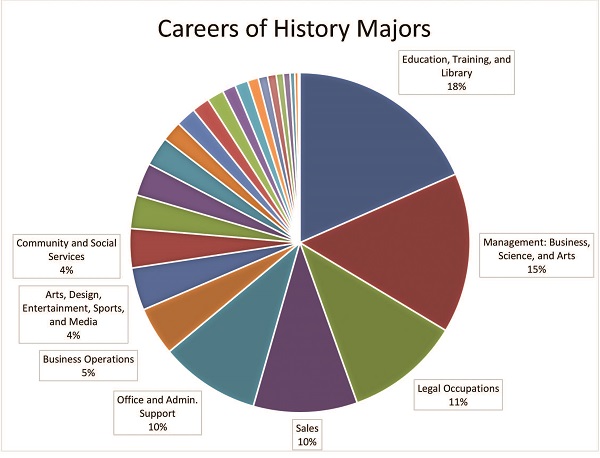
Fig. 1. Data source: ACS 2010–14 5-year Public Use Microdata Sample (PUMS). Includes individuals who stated they were in full-time employment, between the ages of 25 and 64, had achieved a bachelor’s degree or higher, and had either history or US history as the field of study for their bachelor’s degree.

Fig. 1. Data source: ACS 2010–14 5-year Public Use Microdata Sample (PUMS). Includes individuals who stated they were in full-time employment, between the ages of 25 and 64, had achieved a bachelor’s degree or higher, and had either history or US history as the field of study for their bachelor’s degree.

Most myths begin with a kernel of truth that is then warped beyond recognition. The idea that a history degree doesn’t lead directly into a profession is true only for students who expect to become professional historians or to work in a closely related occupation. The vast majority of history majors, of course, do not become professional historians; according to the ACS, only 4.5 percent of history majors become educators at a postsecondary level (that is, mostly college professors). The proportion who become museum professionals—0.5 percent of the total—is a very small slice of the overall pie as well.

But the ACS data imply that many history majors do not expect to become historians and that they find meaningful careers in a wide range of fields. A history degree provides a broad skillset that has ensured that history majors are employed in almost every walk of life, with some notable trends (see fig. 1).

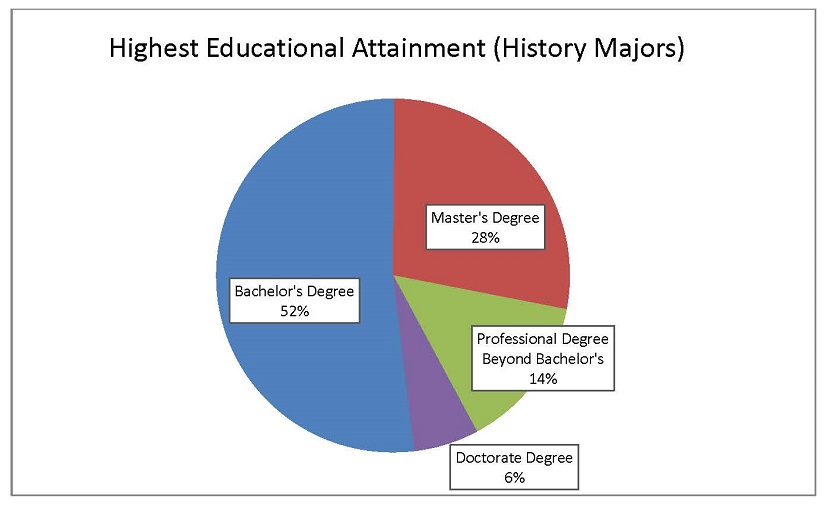
Fig. 2. Data source: ACS 2010–14 5-year Public Use Microdata Sample (PUMS). Includes individuals who stated they were in full-time employment, between the ages of 25 and 64, had achieved a bachelor’s degree or higher, and had either history or US history as the field of study for their bachelor’s degree.

History majors seem particularly well-­prepared for, and attracted to, certain careers. Nearly one in five goes into education—just over half as primary-, middle-, and high-school teachers. Another 15 percent enter management positions in business, and 11 percent go into the legal professions (most becoming lawyers). The “fries” myth is definitely not backed up by the data; only 1.7 percent of history majors work in food preparation, compared to 5 percent of the overall population.

It’s important to note that nearly half of the history majors identified by the ACS went on to graduate school (see fig. 2)—a much higher percentage than the national average (37 percent) and higher than majors in English (45 percent) and the liberal arts (26 percent). This might be because law, management, and education require advanced study. It could also mean that students interested in careers that require graduate training see a history major as a springboard. Likely it is a combination of the two. But knowing this, history departments must understand that it is imperative that they prepare majors for graduate school and offer guidance in educational and career choices.

Myth 3: History Majors Are Underpaid

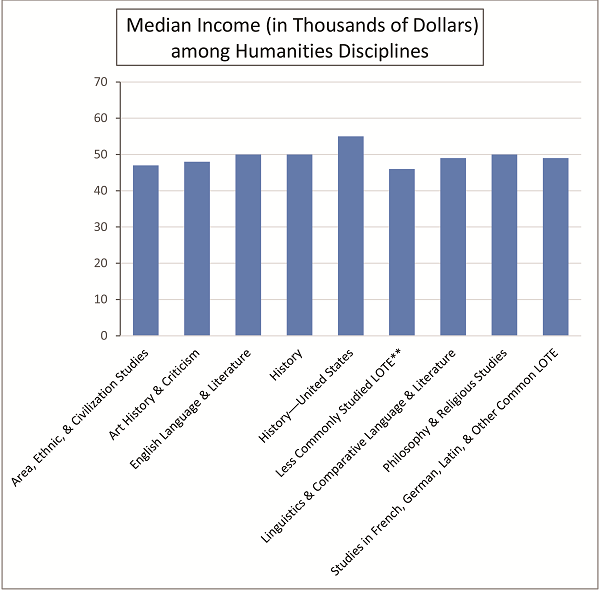
Fig. 3. Data source: American Academy of Arts and Sciences Humanities Indicators, table III-4a. Available at http://www.humanitiesindicators.org/content/indicatordoc.aspx?i=287.

Again, we start with a kernel of truth. The American Academy of Arts and Sciences Humanities Indicators project released an analysis of ACS data showing that those with degrees in the humanities earn less (in terms of median income) than those with degrees in engineering, health care, business, and the sciences (see fig. 3).

Fig. 4. Data source: American Academy of Arts and Sciences Humanities Indicators, table III-4a. Available at http://www.humanitiesindicators.org/content/indicatordoc.aspx?i=287. Methodological note: The ACS survey records undergraduate major by a free-response text block, with no apparent guidance on how to represent a person’s degree. As a result, the number who reported their major as “history” may also include some who studied US history. The overall number of US history majors reported in the ACS is very low, to such a degree that they may make statistical analyses problematic. It is for these reasons that I combine the US history and history majors in my analysis, though the American Academy of Arts and Sciences does not.

Part of this is based more on field than on level of achievement; the work of engineers and computer programmers is better remunerated than that of, for example, elementary school teachers—even though our society demands good teachers. But history fares well in terms of compensation when compared to other humanities majors. The differences in median income among the humanities disciplines are not significant; the disparity between highest- and lowest-­paid humanities majors in the workforce is only a few thousand dollars (see fig. 4).

Data suggest prospects for potential history majors are good, but history departments must offer guidance in career and graduate school choices.

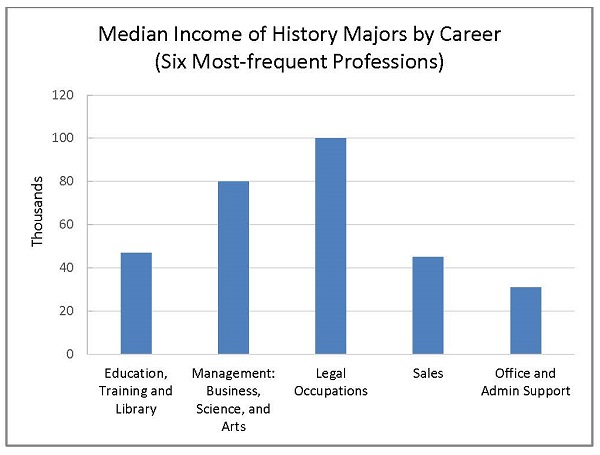
Because of the diversity of careers that humanities majors—particularly history majors—go into, there is a wider-than-­average distribution of incomes based upon field of work (see fig. 5). As in the general workforce, it is the occupation of college graduates in the humanities, rather than their undergraduate major, that accounts for differences in income. For history majors between the ages of 25 and 64 who are neither unemployed nor out of the workforce, the median income is currently $60,000 per year. But for those in managerial positions, the median is $80,000. For those in the legal occupations, the median is $100,000. But for those in education, it is $47,000, and for those who go into community and social services, the median is $45,000.

Fig. 5. Data source: ACS 2010–14 5-year Public Use Microdata Sample (PUMS). Includes individuals who stated they were in full-time employment, between the ages of 25 and 64, had achieved a bachelor’s degree or higher, and had either history or US history as the field of study for their bachelor’s degree.

In short, it is not that history majors are underpaid. It is that the diverse range of occupations that a history degree prepares them for includes several important, but vastly undervalued, public service careers. If the only consideration when choosing a major is whether you will be earning six figures by the age of 30, then history may not be the best field. But for students who are inspired by work in which the greatest rewards may not necessarily be financial, a history major remains an excellent option.

The ACS data shed fascinating light on some of the myths about life with a history degree. Majoring in history does not doom a graduate to a life of unemployment or under­employment. In fact, history majors go on to become much better educated than the average person, filling roles in a wider range of careers than holders of many other degrees. The worst that can be said of this situation is that many of those careers are socially undervalued. But that does not mean that a degree in history is any less valuable.

Methodological note: All ACS data cited in this article include only those individuals between the ages of 25 and 64 who were in full-time employment, who achieved a bachelor’s degree or higher, and who stated that their field of study for their bachelor’s degree was either history or US history. All data were taken from the ACS’s 2010–14 5-year Public Use Microdata Sample (PUMS). Data on the number of history bachelors’ degrees awarded in 2015 were gleaned from the annual National Center for Education Statistics via the NSF’s WebCASPAR system at https://ncsesdata.nsf.gov/webcaspar.

Paul B. Sturtevant is a medievalist, social scientist, and public historian. He received a PhD in medieval studies from the University of Leeds and is a social science analyst at the Smithsonian Institution, as well as editor in chief of The Public Medievalisthttp://www.publicmedievalist.com/.

img_8076