Walk out!

Teacher Pay

Here we go! as last posted here Labor lessons from former coal country

We are now in the midst of a genuine walk out.  Best of luck educators throughout West Virginia!

This is a pre-K through college fight and we need to have each other’s backs–adjuncts, Pre-K teachers, K-12, and the post-secondary tenured, together, are a mighty, mighty force in this country. Let’s have some solidarity.


From Dissent.com  (Full article here)

“When Logan County special education teacher Leah Clay Stone entered the West Virginia capitol building on February 2, she saw a sea of teachers from the chamber doors of the Senate and House all the way back to the rotunda. Her county was part of the first work stoppage this month that saw public school teachers flock to the capitol building in Charleston to protest continued low wages, spiking insurance premiums, and poor working conditions.

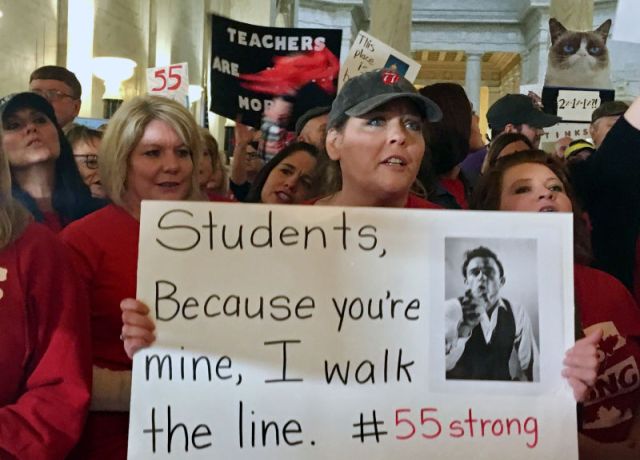
The teachers flooding the galleries that day came from schools in just three counties. But since February 2 the rebellion has spread. Today marks the second day of a statewide work stoppage, with schools closed in all fifty-five counties. The teachers—who don’t even have legal collective bargaining—wear red T-shirts with the outline of West Virginia and the word UNITED emblazoned across them, a visual that calls to mind not only the Chicago teachers’ strike of 2012 but also the Wisconsin capitol occupation in 2011, against Governor Scott Walker and the Republican legislature’s move to take away collective bargaining rights from the state’s public employees. Now West Virginia public employees are showing that even without collective bargaining rights, they too can make a heck of a lot of noise.

On Thursday morning, thousands of teachers headed to the capitol, carpooling because the walkout included bus drivers. Others stayed close to home to make sure they had a presence in their schools, where they were met with support from students and parents. That support has been building over recent weeks: Ashlea Bassham’s ninth- and tenth-grade students and others had already held their own walkout in Logan County, wielding signs that read “I’m in the bleachers for my teachers.” Parents have held informational pickets and walk-ins, standing outside schools in the cold and the snow to support the teachers. The movement has spread from county to county, neighbor to neighbor, as teachers who live in one county and work in another talk to friends at home and on the job. “It literally was like a fire just catching and going,” says Stone, who is the local vice-president for the Logan County Education Association, one of the two associations in the state.

At the beginning of the legislative session, the executive committee of the association called an emergency meeting to discuss changes to their insurance plan and other bills being introduced in the legislature. The teachers called for a vote to walk out. “I don’t think there was anybody still seated. It was a resounding yes,” Stone said. She then put her production-management background to use pulling together a voting process, getting representatives from every school to collect ballots. “We managed to get ballots into every school and all three bus garages and had them back into my hands and counted in twenty-four hours,” she said. “I literally was creating a ballot as I was walking out the door of the building. I was like ‘somebody else needs to drive, I need to take care of this.’”

The teachers were trying to avoid the district getting an injunction to halt their action, but instead the superintendent closed the schools, a pattern that would repeat itself in every county across the state as teachers stood up to join the statewide day of action. A movement organized by teachers on the ground was able to spread in part through existing networks, in part through social media. “A lot of people blame Facebook for all the bad things in 2016 with the election, but it has actually been really helpful here because West Virginia is so rural and spread out,” said Jay O’Neal, who teaches in Charleston.

Like other teachers who have resorted to stopping work in recent years, the West Virginia teachers have emphasized that their goal is to make education better for every child in West Virginia. “Teachers’ working conditions are students’ learning conditions” has become the byword in these campaigns. The West Virginia teachers have demonstrated this commitment not only with their demands—for filling teacher vacancies, for smaller class sizes—but with immediate action. “As soon as we called the work stoppage for Thursday and Friday our locals took it upon themselves to start working with churches and food banks and different places to provide day care for the parents who needed it, to provide meals for the many students who get their hot meals at school,” said Dale Lee of the West Virginia Education Association (WVEA).

The legislature and the board of the Public Employees Insurance Agency (PEIA) have begun to make some noises about conceding some to the teachers’ demands, but nothing is concrete and the work stoppage is set to continue at least through Monday.


The teachers began to notice trouble in January, right at the beginning of the legislative session. In that first session, Bassham noted, there were over thirty bills introduced that seemed ominous. When it comes to salaries, West Virginia teachers are already some of the worst off in the country—forty-eighth, according to Lee—and their health-insurance premiums had increased so much over the last year that it amounted to a pay cut. “I keep seeing this number thrown around—$45K is the average teacher salary. I’ve been teaching for seven years and I am nowhere near that,” Stone said. O’Neal added, “I moved here in 2015 and my second year teaching, I made less than my first.”

That pay cut came from a change to how PEIA insurance was calculated—it shifted from being based on the individual teacher’s income to total family income. That could effectively double the already-high premiums for insurance that used to be seen as a counterbalance to low wages. On top of that, the teachers would be penalized if they did not participate in a wellness program.

Those issues already left teachers feeling undervalued and disrespected. And that came on top of legislators proposing bills that threatened public education—such as introducing charter schools, “education savings accounts” (giving parents public funds to spend on educating their children, or a “backdoor voucher” in Lee’s words), so-called “paycheck protection,” which restricts the ability for automatic deduction of union dues, and other attacks on the already deeply restricted unions. Anger at the anti-union proposals opened the door to bring up other issues that had been frustrating teachers for much longer, like sky-high class sizes in secondary schools and a lack of electives for students.

Despite it all, Lee noted, “We have great schools. We’re right at 90 percent graduation rate, and for a rural state that is exceptional.” To him, legislators’ complaints about spending are disingenuous—the state is paying for past underfunding of retirement benefits and counting those dollars as education spending. Because West Virginia’s population is quite spread out, that also means that transporting students costs more than it would in more densely populated states—more dollars that aren’t going to the classroom but are still necessary to spend.

Meanwhile the state has a shortage of certified teachers because it’s hard to convince people to enter a job when starting salaries for people with advanced degrees are still in the $30–35,000 range. “You’re sold the idea of, hey, go to college, get a degree, get an advanced degree, and then you still really can’t make ends meet,” Bassham said. “Obviously we do it because we like the kids, but I also like to be able to pay my bills and not have $8 to last me six days until payday.”


Leah Clay Stone is a second-generation member of the West Virginia Education Association (WVEA)—she and her walked picket lines with her mother during a 1990 teacher strike. Her father was a coal miner through the 1980s. West Virginia is a state with a proud labor history that gets lost in the “Trump Country” profiles. Many of the teachers in today’s fight have personal experiences like Stone’s. It was not lost on anyone I spoke with that the first teachers to stop work were from coal country, from Mingo and Logan Counties, the sites of the great mine wars.

Stone also recalls, as a teenager, going to party with friends on top of the infamous Blair Mountain, the site of what historian Elizabeth Catte, in her new book What You Are Getting Wrong About Appalachia, calls “the largest show of armed resistance in the United States since the Civil War—and the most significant labor uprising in the United States.” Immortalized in part in the 1987 movie Matewan and in memorable labor ballads, the Battle of Blair Mountain pitted workers and their allies—like venerable labor agitator Mary Harris “Mother” Jones—against a “private army” that would later be praised by the National Rifle Association (yes, the same one that currently wants to arm teachers against school shooters). It is a stark reminder that West Virginians died to organize the unions that the state’s officials are currently bad-mouthing in the press.

Today’s action is the first statewide walkout of teachers in almost thirty years. “If you look at what teachers and their allies are posting on social media, you can see that they are connecting the upcoming action to the state’s important history of labor uprising, from Blair Mountain to Widen.” Elizabeth Catte told me via email. She pointed to a tweet from Richard Ojeda, a candidate for Congress from the state, who posted a photograph of himself in a red bandanna with the caption, “The term redneck started when WV coal miners tied red bandanas around their necks during the bloody battle of Blair mountain to unionize. Today, our teachers channeled their history. #UnionStrong”

“It’s rather impressive to me that people don’t have the knowledge of what it means to be union proud. Or what it means to be involved in an organization,” Stone, who recalled doing a school project on Mother Jones, said. “For the past few years we’ve struggled to keep membership even in our organization. But in this moment and this movement people have been finding out that they are the movement. If they want something done they have to speak up.”

These days, of course, the labor movement is a shadow of its former self in terms of both militancy and membership. With collective bargaining banned for West Virginia teachers and public-sector workers, unions are voluntary associations—meaning that teachers at any given school might be members of the WVEA or the American Federation of Teachers-West Virginia (AFT-WV), or neither. Without collective bargaining, the WVEA’s Dale Lee explained, mostly the associations fight to get work issues that unions might bargain over—like duty-free lunches and planning periods—written into state law.

There is a separate association for school service personnel, the West Virginia School Service Personnel Association, who have also backed the job action—cooks, custodians, maintenance workers, and bus drivers. Beyond that, Bassham told me, they are standing for all public employees who are struggling. “It’s not just a teacher issue, it’s not just a school issue, it’s our state not wanting to take care of the people who are trying to make our state a better place.”

Their message is a reminder that despite pollsters’ tendency to make a college degree the dividing line between “working” and “middle” class, the categories are often not so clear cut. The reality is that college-educated workers too have to fight for decent wages and benefits. That the teachers all cite Blair Mountain’s miners as inspiration is an act of class solidarity and a reminder that the so-called knowledge economy we have been told to prize over manual labor doesn’t come with a guarantee of good pay any more than coal mining did.

West Virginia’s government has long been dominated by coal and other extractive industries. In fact its sitting governor, Jim Justice, is a second-generation coal tycoon and a billionaire who owes his own state millions in back taxes. But Jay O’Neal is heartened that teachers and their supporters—including the mine workers’ union—are now calling for raising taxes on those extractive companies in order to fund education. In a literal sense, the teachers are fighting the same companies that the coal miners were, decades ago.


On Thursday teachers from all three education workers’ associations took to the streets and the capitol halls, dressed in red, bearing handmade signs, some of them wearing those red bandannas. They waved to passing drivers and marched with other unionists. Schools throughout the state remained shuttered Friday, and at an afternoon press conference, union representatives said they were prepared to continue the walkout until the state commits to address their demands: higher pay, fully funded insurance benefits, and rejection of the regressive bills.

Teachers had already driven to the capitol on snow days, on treacherous mountain roads. “Our colleagues in the northern panhandle and the eastern panhandle have to come so much further,” Bassham said. “They drove on some crazy mountain roads to holler at legislators, and it was fabulous.”

Those legislators are slowly beginning to take action, Stone said, though there is also “quite a bit of grandstanding. . . . They want you to think that they’re doing everything they can for you but their voting record doesn’t show that.”

Public-employee strikes in West Virginia, as state Attorney General Patrick Morrisey has stated, are illegal. And yet the teachers have gone out anyway, taking the risk because it can’t get much worse for them. With the Janus case looming before the Supreme Court, potentially decimating every public-sector union in the nation, and right-wing governors looking for additional ways to punish unions, the West Virginia teachers’ situation is a bellwether.

These teachers recall that there were no laws protecting the mine workers in the 1920s either. Stone said, “West Virginians have a long background of doing what’s expected until it gets to be too much, and then we make sure we do what’s right, and we really want our legislators to do what’s right instead of what’s expected.”

Mother Jones would be proud.”


Hell yes she would.
sbsdcrtnoekiluxbe20j

Labor lessons from former coal country

Some Motivation from West Virginia. The battle hardened state has a long history of labor struggle. This bit comes from Krystal Ball at the TheHill.com All eyes on

Could this be the moment the labor movement has been waiting for?

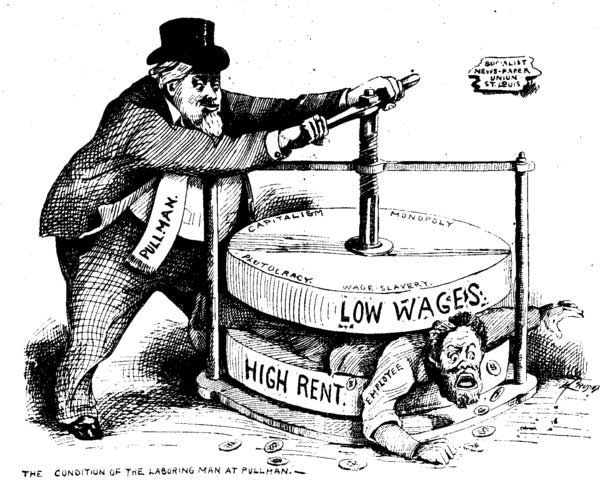
pullman

Link Here

It’s been a rough couple of decades for the national labor movement. Unions have been subjected to a full blown assault by the GOP, eroded by new work arrangements and all but abandoned by Democrats. Major newspapers no longer employ labor reporters, 28 states have undermined unions with so-called right-to-work laws, the Trump administration has decimated the National Labor Relations Board, and every year brings another grim statistic about how union membership has fallen.

With this set of facts piling up, plenty of people have decided unions are now irrelevant and left the movement for dead. Turns out, though, that West Virginia didn’t get the memo.

Teachers, school service personnel and other public employees in the Mountain State are on the verge of a historic statewide walkout over pay that’s near the worst in the country. Over the past few weeks, these workers have staged local walkouts, flooded town halls, and descended by the thousands on the state capital in Charleston. Today, teachers will walk out of schools in at least three more counties, and on Saturday they’ll rally in a massive protest at the Capitol building in what is expected to be their largest action to date.


With no sign that the Republican-dominated legislature is going to accede to the teachers’ demands for a decent wage, the only avenue left is a coordinated statewide walkout. According to Dale Lee, president of the West Virginia Education Association, the state’s largest teachers union: “Unless things change, we’re headed toward a work action.”

It’s hard to overstate just what a dramatic scene this will be. When thousands of teachers walk out of West Virginia schools, they’ll be bucking a national trend in a big way. Last year was the second lowest year ever recorded for large-scale strikes. In the entire country for the entire year, there were only 7 strikes involving more than 1,000 workers.

If you’re surprised to see a resurgence in progressive radical action coming from West Virginia, then it’s time you toss out your old stereotypes of West Virginians as an endlessly trod-upon people who don’t understand their own self-interest and reflexively back Republicans. You may also want to revisit your history.

West Virginia was a cradle of militant unionism and the site of some of the most storied, important battles between labor and management. In fact, if you’ve ever called someone a “redneck” or been called one yourself, you can trace that proud pejorative back to one of the bloodiest battles between labor and management to occur in our nation’s history. In the Battle of Blair Mountain, miners literally fought against management and government for their right to organize and to earn cash instead of scrip and to shop outside of company stores. In order to easily identify their brothers in arms, the miners wrapped red bandanas around their necks.

You might also be surprised to learn that those rednecks were composed of whites, black migrants from the South and new European immigrants. They spoke different languages, came from different cultures, but their red bandanas stood as a sign of cross-racial, working-class solidarity.

In other words, West Virginia may be the perfect place for workers to once again disregard the rules meant to keep them in their place. The perfect place for workers to demand more from a system that has been systematically rigged to deliver for business and the politically connected at the expense of working people in every community. The perfect place to lead a vanguard of progressive activism that just might be the jolt the entire national labor movement needs.

These modern-day rednecks are ready to fight.

June_30_1917 cr

Krystal Ball is president of The People’s House Project, which recruits Democratic candidates in Republican-held congressional districts of the Midwest and Appalachia. A former candidate for Congress in Virginia and host on MSNBC’s “The Cycle,” she is a video host for the soon-to-be-launched Hill.TV project. Follow her on Twitter @krystalball.

Monday Mornin’

Monday Morning comes at you hard some weeks. I’ve noticed that for some of us, immersed in the digital age, the lines between the work week and the weekend have a tendency to blur quite a bit. I wanted to share a slice of motivation, in the form a brief TED talk. Kick Monday motivation square in the pants.

For those who are constantly online and working even on the weekends, stress is an all too common a feeling. But to feel so at the start of a fresh week is not likely to do much for your productivity. However, Kelly McGonigal, a health psychologist, in this talk, shares her findings on how we can (and need to) re-calibrate our minds to view stress contrarily, different than our current notion/belief of it is as a life-threatening disease of sorts. Kelly talks about perspective changes, how one can try to see stress as a sign of action-readiness. About how we can view our stress responses as helpful and not harmful. Her suggestions on how we can befriend-stress are simple and worth giving a try.

IMG_0246

What do you think? Any methods you might recommend? Leave some love.

An Open Letter to the Interim President, Provost, and Board of Trustees of Michigan State University

Michigan_State_University_seal.svg

From the MSU Faculty, As found here https://msufic.wordpress.com/  (Follow the link to add your name to the list)

AN OPEN LETTER TO THE INTERIM PRESIDENT, PROVOST, AND BOARD OF TRUSTEES OF MICHIGAN STATE UNIVERSITY


Our Observations Concerning Michigan State University’s Climate

We the undersigned Faculty are horrified by Nassar’s crimes and compelled by the growing sense that Michigan State University (MSU) officials have remained silent in the face of sexual violence against women on campus. Our hearts go out to the survivors, those courageous young women who have stood up in court, given statements and exposed, not only Nassar, but also the failures of the University to respond to their reports of abuse.

There are certainly many more survivors of abuse on campus whose voices, however, have not been heard or whose reports have been disregarded.  The Nassar scandal has revealed that MSU administrative practices have tolerated and even been complicit with multiple forms of abuse, all the while claiming to put student interests first.

It is long past time to address the breadth and depth of our institutional dysfunction. Merely removing the abusers and replacing those who are ultimately responsible for institutional failures is not a satisfactory response. The entire culture of the university must be fundamentally reordered and remade. In this spirit, we present this list of demands that will help begin the process of addressing the past crimes and administrative failures and moving MSU towards a future in which sexual violence will not be tolerated on campus.

Regarding Sexual Abuse

  1. All new Board of Trustees members must have demonstrable deep familiarity with issues surrounding sexual assault and rape culture and other forms of abuse that are common inside a large institution.
  2. The next MSU president must have demonstrable deep familiarity with issues surrounding sexual assault and rape culture and other forms of abuse that are common inside a large institution.
  3. There must be transparency about steps taken to address sexual assault on the MSU campus.
  4. There must be transparency about steps taken to make the MSU administration accountable for failure to respond adequately to sexual assault.
  5. All people directly involved in covering up these sexual assaults must be immediately suspended.
  6. We must create a dedicated Sexual Assault Center with counselors and budget for advocacy and activities, and increase the number of sexual assault counselors after a series of exit interviews with those counselors who have left in protest.

Regarding Providing a Forum for Discussion of this Crisis and Reestablishing Trust between Members of the MSU Community

  1. We should cancel all classes and dedicate an entire day to campus discussion.
  2. All coaches must face the MSU faculty and answer questions in an open meeting.
  3. There must be a Town Hall meeting for students with the interim President, his advisors, the Provost and the entire Board of Trustees.
  4. There must be a Town Hall meeting for faculty with the interim President, his advisors, the Provost and the entire Board of Trustees.

Regarding Governance and Reorganization

  1. After the current Board of Trustees meets with the students and faculty, we expect they will resign or be impeached.
  2. MSU’s Faculty Governance structure is an aberration. Our Faculty Governance must mirror the autonomy given to faculty elsewhere throughout this nation.  For some background and suggestions, we refer you to the Report of the Ad Hoc Committee on Faculty Voice dated April 22, 2005 which was never seriously implemented.
  3. We wish to know the criteria used by the Board of Trustees to select Acting and Interim Presidents.
  4. We wish to have a list of those in academic HR who knew about the Nassar and other sexual assaults and when they became aware of these incidents.
  5. The new Board of Trustees must include in its list of primary responsibilities regaining the trust of the Faculty.
  6. New members of the Board of Trustees must have demonstrated interest in the academic mission of the university, not athletics, and must be appointed for a limited transition period until elections can be held.
  7. The process of selecting a new President must be totally transparent. We remind everyone that Lou Anna Simon was chosen without a national search and hired as the result of a closed door Board of Trustees meeting.
  8. We wish to know the names of the law firms and insurance firms that have been retained.

Regarding Other forms of Institutionalized Abuse

  1. We must examine the structures of abuse which have been normalized throughout this University and employ only those who are both willing to and capable of resisting the furtherance of such abuse. The mantra which appears in so many of MSU’s official documents regarding racism, sexism, classism, ableism, normative gender roles, etc. must not be a meaningless chant.
  2. We must study the enormous body of scholarly work which enlightens us to how abuse has been institutionalized here.

Regarding Financial and Other Costs to the University

  1. We must be given a written commitment that the faculty will not incur the cost of administrative failure (possibly over 1 billion dollars) in the Nassar case.
  2. We remind everyone that as the majority of students are residents of Michigan, any increase in their tuition is a tax on Michigan residents.

Writing tips from Nomadic Matt

If  you ever venture through the world of travel writing, you will run across Nomadic Matt.  I dig his stuff.  I wanted to share a recent post on writing tips that I found super  helpful Find the site here

His site is a kind of institution, and deservedly so. He’s been in the game for quite a while, and is typically ranked as one of the busiest travel blogs on the web. I found this guide a great primer, and wanted to share with the community here.

img_8895

This post is a little inside baseball about travel writing. It’s a follow-up to my semi-ongoing series on travel blogging that started with this post, continued with this one, and will now (probably) end with this post here. To me, the crux of all online endeavors is good writing. With so many blogs out there, if you can’t write engaging stories, you’ll never get anywhere! So today, I want to introduce one of my favorite travel writers, David Farley, who is going to share 11 writing tips for fellow bloggers and writers out there! Here’s David:

I always thought that once I started writing for glossy travel magazines, I could relax a bit because I’d “made it.” Nope! Then I thought that once I began penning pieces for the New York Times, I could say I was successful. Not. At. All. OK, maybe when I had a book out, published by a major publishing house, things would get a bit easier for me. I wish!

Writers, in some way, are a sorry lot. Rarely do they ever look at something and say “perfect!” Maybe for a moment — but give a writer a day and he or she will come back to that same article and find dozens of mistakes. Writing is a craft you never perfect.

We’re always striving to be better. Creatives tend to be perfectionists. Writing requires you to keep learning and improving.

But that’s good, because that drive makes writers improve their work. And only through practice and effort do we end up with the Hemingways, Brysons, Gilberts, and Kings of the world. (Matt says: I once heard that until the day he died, Frost never loved “The Road Not Taken.” He was constantly reworking it!)

If you’re a travel blogger, you probably started off not as a writer with a journalism background but as a traveler looking to share your experience. You probably didn’t have any formal training or someone to peer over your shoulder and give you advice.

So today I wanted to share 11 tips that will help you improve your travel writing or blogging. Because the world always needs good writers — and good writing helps get your story heard more! These tips, if followed, will better your writing and make a huge difference in the reach of your writing!

11 Ways to Improve Your Travel Writing/Blogging

an ope notebook on a desk, photo by @waferboard (flickr)
1. Read. This is number one. because whenever a budding writer asks me how they can improve, it’s my first piece of advice. Read good writing. Absorb it. Let it sink into your soul. Don’t think it’s possible? When I was first starting out, I was sick one weekend, so I spent three days lying in bed reading every page of that year’s Best American Travel Writing anthology. After I finished, I opened up my laptop and started writing for the first time in days. What came out surprised me: it was the highest-quality writing I’d done to date. And it was all because I was absorbed in good writing and it filtered through me back onto the page in my own writing.

(Matt says: Here’s a list of my favorite travel books.)

2. Do it for love. Maya Angelou wrote, “You can only become truly accomplished at something you love.” Don’t get into travel writing for the money — after all, that would be totally unrealistic. And please don’t gravitate to the genre because you want free trips and hotel rooms. “Instead,” Ms. Angelou added, “do [it] so well that people can’t take their eyes off of you.” Or, in other words, strive to become such a good writer that the editors of all the publications you have been dreaming to write for can’t ignore you anymore.

3. Don’t be attached to linear writing. You need not compose a piece from beginning to middle to end. Sometimes that’s not the ideal structure of the story. Sure, maybe you’ve already figured that out. But if not, it’s OK to just get a few scenes and paragraphs of exposition down “on paper.” Then you can step back and take a look at the bigger picture and rearrange what you have, figuring out the best way to tell the story.

4. Tap into your own sense of motivation and drive. The students of mine at New York University who have been most successful were not always the most talented in the class. But they were the most driven. They’d read enough quality writing and thought about it — understanding what made it so wonderful — that there was just something about writing that they got. They weren’t born with that understanding, but ambition drove them to seek out better writing and then to think about it, to analyze what made it good (or not so good). Drive also inspires future successful writers to go out on a limb, to render themselves vulnerable, by reaching out to more accomplished writers to ask for advice, or by introducing themselves to editors at events or conferences. Don’t be shy! Standing in the corner quietly won’t get you as far as putting your hand out to introduce yourself will.

5. Try to figure out what gets your mind and writing flowing. Let me explain: I can sit down at my laptop and stare at a blank Word document for hours, not sure how to start a story or what to write about. Then I’ll respond to an email from a friend who wants to know about the trip I’m trying to write about. I’ll write a long email with cool and interesting anecdotes about my experience and include some analysis about the place and culture. And then I’ll realize: I can just cut and paste this right into the empty Word doc I’ve been staring at for the last three hours! Several of my published articles have blocks of texts that were originally written as parts of emails to friends. The “email trick” might not work for everyone, but there is inevitably some trick for the rest of you — be it talking to a friend or free-associating in your journal.

6. Understand all aspects of storytelling. There are two types of travel writing: commercial and personal essay (or memoir). In commercial travel writing, you should make the various parts of the story an intrinsic aspect of your knowledge: from ways to write a lede to the nut graph, scenes, exposition, and conclusions. For memoir and personal essays, know what narrative arc means like the back of your typing hands. It helps to get an intuitive understanding of these things by paying attention to writing — to reading like a writer — as you read nonfiction (and travel) articles.

7. Don’t stress if your first draft is shit. Ernest Hemingway said, “The first draft of anything is shit.” And he wasn’t kidding. I find this true when I’m writing a personal essay or travel memoir. I write and I write and I write, and I’m not exactly sure what I’m putting down on paper. What’s the point of this? I ask myself. Why am I even doing this? But here is where patience comes in: eventually, the clouds part, the proverbial sunbeam from the heavens shines down on our computer monitors, and we see the point of it all: we finally figure out what it is we’re writing and how to best tell that story. It just happens like magic sometimes. And not all at once: sometimes it’s bit by bit, like putting together a jigsaw puzzle. But as I mentioned, patience is key, because we never know when that divine magic is going to be activated. But sit around long enough and it will happen, I promise you. (Just be cautious when taking Hemingway’s other writing advice: “Write drunk, edit sober.”)

8. Write what you know. “Start telling the stories that only you can tell,” said writer Neil Gaiman, “because there’ll always be better writers than you and there’ll always be smarter writers than you. There will always be people who are much better at doing this or doing that — but you are the only you.”

9. When you’re finished with a draft, read it out loud. Preferably, print it out and read it out loud. This will allow you to better hear how the piece sounds, and unacceptable segues and clunky sentences or turns of phrases will jump out at you in a more obvious way.

10. Always get another set of eyes on your writing. While all writers make mistakes, it’s harder to spot them without an editor. Editors are very important, but they don’t necessarily have to be someone with formal training. While hiring a copyeditor is always great, if you can just get a friend to read your blog or story, that might be good enough.

It’s even better if you have someone who doesn’t know about travel. I have a friend who doesn’t travel much; she reads all my blog posts because she helps me make sure I include the important details I might have skipped. See, when you’re an expert on something, you often fill in the blanks in your mind. You go from A to C automatically; step B becomes subconscious. And when you write, you skip step B because it seems so obvious. Getting someone who doesn’t know the steps will help ensure you include explain everything in your post and don’t leave your readers going, “Huh?”

11. Finally, learn to self-edit. This is where many people go wrong. They write, they read it over, they post. And then feel embarrassed as they say, “Oh, man, I can’t believe I missed that typo.” You don’t need to be master editor, but if you follow a few principles, it will go a long way: First, write something and let it sit for a few days before editing. After your first round of edits, repeat the process. Get another set of eyes on it. Print out a checklist of grammar rules to go through as you edit. (Note: Matt created one here for you.) As you review your work, say to yourself, “Did I do this? Did I do that?” If you follow the cheat sheet, you’ll catch most of your mistakes and end up with a much better final product!

Writing is an art form. It takes a lot of practice. When you’re a blogger out on your own, it can be harder to improve your work, because you don’t have an experienced voice giving you tips and advice and pushing you to be better. If you don’t take it upon yourself to be better, you never will be. However, even if you aren’t blessed to work under an editor, these 11 tips can help you improve your writing today and become a much better blogger, writing stories people want to read!

David Farley has been writing about travel, food, and culture for over twenty years. His work has appeared in AFAR magazine, the New York Times, the Washington Post, Condé Nast Traveler, and World Hum, among other publications. In 2006 and 2013, he won the Lowell Thomas Award from the Society of American Travel Writers for magazine articles he wrote. He has lived in Prague, Paris, and Rome and now New York City. He is the author of An Irreverent Curiosity and was a host for National Geographic. He teaches writing at Columbia University and New York University.


How the Academic Elite Reproduces Itself

Another great piece by Chad Wellmon. What about the questions of higher education and the digital age…The university is a technology.

chad wellmon's avatar

This essay, written with Andrew Piperfirst appeared on October 8, 2017 in The Chronicle of Higher Education.

Ten years ago, the Higher Education Funding Council for England decided to “assess” the quality of research in universities across Britain by putting in place a new system, the Research Excellence Framework. In 2014, the Council and its institutional partners released a report that included evaluations of almost 200,000 “research outputs” ­— including journal articles, books, and conference proceedings. Since then academics on both sides of the Atlantic have ridiculed the REF, as the framework is known, as a bureaucratic boondoggle that values quantity over quality.

Despite the derision, analytic exercises such as the REF or the use of commercial databases, such as Academic Analytics, by universities in the United States have come to stand for a basic truth about the contemporary research university: Publications are the most fundamental…

View original post 2,498 more words