Writing tips from Nomadic Matt

If  you ever venture through the world of travel writing, you will run across Nomadic Matt.  I dig his stuff.  I wanted to share a recent post on writing tips that I found super  helpful Find the site here

His site is a kind of institution, and deservedly so. He’s been in the game for quite a while, and is typically ranked as one of the busiest travel blogs on the web. I found this guide a great primer, and wanted to share with the community here.

img_8895

This post is a little inside baseball about travel writing. It’s a follow-up to my semi-ongoing series on travel blogging that started with this post, continued with this one, and will now (probably) end with this post here. To me, the crux of all online endeavors is good writing. With so many blogs out there, if you can’t write engaging stories, you’ll never get anywhere! So today, I want to introduce one of my favorite travel writers, David Farley, who is going to share 11 writing tips for fellow bloggers and writers out there! Here’s David:

I always thought that once I started writing for glossy travel magazines, I could relax a bit because I’d “made it.” Nope! Then I thought that once I began penning pieces for the New York Times, I could say I was successful. Not. At. All. OK, maybe when I had a book out, published by a major publishing house, things would get a bit easier for me. I wish!

Writers, in some way, are a sorry lot. Rarely do they ever look at something and say “perfect!” Maybe for a moment — but give a writer a day and he or she will come back to that same article and find dozens of mistakes. Writing is a craft you never perfect.

We’re always striving to be better. Creatives tend to be perfectionists. Writing requires you to keep learning and improving.

But that’s good, because that drive makes writers improve their work. And only through practice and effort do we end up with the Hemingways, Brysons, Gilberts, and Kings of the world. (Matt says: I once heard that until the day he died, Frost never loved “The Road Not Taken.” He was constantly reworking it!)

If you’re a travel blogger, you probably started off not as a writer with a journalism background but as a traveler looking to share your experience. You probably didn’t have any formal training or someone to peer over your shoulder and give you advice.

So today I wanted to share 11 tips that will help you improve your travel writing or blogging. Because the world always needs good writers — and good writing helps get your story heard more! These tips, if followed, will better your writing and make a huge difference in the reach of your writing!

11 Ways to Improve Your Travel Writing/Blogging

an ope notebook on a desk, photo by @waferboard (flickr)
1. Read. This is number one. because whenever a budding writer asks me how they can improve, it’s my first piece of advice. Read good writing. Absorb it. Let it sink into your soul. Don’t think it’s possible? When I was first starting out, I was sick one weekend, so I spent three days lying in bed reading every page of that year’s Best American Travel Writing anthology. After I finished, I opened up my laptop and started writing for the first time in days. What came out surprised me: it was the highest-quality writing I’d done to date. And it was all because I was absorbed in good writing and it filtered through me back onto the page in my own writing.

(Matt says: Here’s a list of my favorite travel books.)

2. Do it for love. Maya Angelou wrote, “You can only become truly accomplished at something you love.” Don’t get into travel writing for the money — after all, that would be totally unrealistic. And please don’t gravitate to the genre because you want free trips and hotel rooms. “Instead,” Ms. Angelou added, “do [it] so well that people can’t take their eyes off of you.” Or, in other words, strive to become such a good writer that the editors of all the publications you have been dreaming to write for can’t ignore you anymore.

3. Don’t be attached to linear writing. You need not compose a piece from beginning to middle to end. Sometimes that’s not the ideal structure of the story. Sure, maybe you’ve already figured that out. But if not, it’s OK to just get a few scenes and paragraphs of exposition down “on paper.” Then you can step back and take a look at the bigger picture and rearrange what you have, figuring out the best way to tell the story.

4. Tap into your own sense of motivation and drive. The students of mine at New York University who have been most successful were not always the most talented in the class. But they were the most driven. They’d read enough quality writing and thought about it — understanding what made it so wonderful — that there was just something about writing that they got. They weren’t born with that understanding, but ambition drove them to seek out better writing and then to think about it, to analyze what made it good (or not so good). Drive also inspires future successful writers to go out on a limb, to render themselves vulnerable, by reaching out to more accomplished writers to ask for advice, or by introducing themselves to editors at events or conferences. Don’t be shy! Standing in the corner quietly won’t get you as far as putting your hand out to introduce yourself will.

5. Try to figure out what gets your mind and writing flowing. Let me explain: I can sit down at my laptop and stare at a blank Word document for hours, not sure how to start a story or what to write about. Then I’ll respond to an email from a friend who wants to know about the trip I’m trying to write about. I’ll write a long email with cool and interesting anecdotes about my experience and include some analysis about the place and culture. And then I’ll realize: I can just cut and paste this right into the empty Word doc I’ve been staring at for the last three hours! Several of my published articles have blocks of texts that were originally written as parts of emails to friends. The “email trick” might not work for everyone, but there is inevitably some trick for the rest of you — be it talking to a friend or free-associating in your journal.

6. Understand all aspects of storytelling. There are two types of travel writing: commercial and personal essay (or memoir). In commercial travel writing, you should make the various parts of the story an intrinsic aspect of your knowledge: from ways to write a lede to the nut graph, scenes, exposition, and conclusions. For memoir and personal essays, know what narrative arc means like the back of your typing hands. It helps to get an intuitive understanding of these things by paying attention to writing — to reading like a writer — as you read nonfiction (and travel) articles.

7. Don’t stress if your first draft is shit. Ernest Hemingway said, “The first draft of anything is shit.” And he wasn’t kidding. I find this true when I’m writing a personal essay or travel memoir. I write and I write and I write, and I’m not exactly sure what I’m putting down on paper. What’s the point of this? I ask myself. Why am I even doing this? But here is where patience comes in: eventually, the clouds part, the proverbial sunbeam from the heavens shines down on our computer monitors, and we see the point of it all: we finally figure out what it is we’re writing and how to best tell that story. It just happens like magic sometimes. And not all at once: sometimes it’s bit by bit, like putting together a jigsaw puzzle. But as I mentioned, patience is key, because we never know when that divine magic is going to be activated. But sit around long enough and it will happen, I promise you. (Just be cautious when taking Hemingway’s other writing advice: “Write drunk, edit sober.”)

8. Write what you know. “Start telling the stories that only you can tell,” said writer Neil Gaiman, “because there’ll always be better writers than you and there’ll always be smarter writers than you. There will always be people who are much better at doing this or doing that — but you are the only you.”

9. When you’re finished with a draft, read it out loud. Preferably, print it out and read it out loud. This will allow you to better hear how the piece sounds, and unacceptable segues and clunky sentences or turns of phrases will jump out at you in a more obvious way.

10. Always get another set of eyes on your writing. While all writers make mistakes, it’s harder to spot them without an editor. Editors are very important, but they don’t necessarily have to be someone with formal training. While hiring a copyeditor is always great, if you can just get a friend to read your blog or story, that might be good enough.

It’s even better if you have someone who doesn’t know about travel. I have a friend who doesn’t travel much; she reads all my blog posts because she helps me make sure I include the important details I might have skipped. See, when you’re an expert on something, you often fill in the blanks in your mind. You go from A to C automatically; step B becomes subconscious. And when you write, you skip step B because it seems so obvious. Getting someone who doesn’t know the steps will help ensure you include explain everything in your post and don’t leave your readers going, “Huh?”

11. Finally, learn to self-edit. This is where many people go wrong. They write, they read it over, they post. And then feel embarrassed as they say, “Oh, man, I can’t believe I missed that typo.” You don’t need to be master editor, but if you follow a few principles, it will go a long way: First, write something and let it sit for a few days before editing. After your first round of edits, repeat the process. Get another set of eyes on it. Print out a checklist of grammar rules to go through as you edit. (Note: Matt created one here for you.) As you review your work, say to yourself, “Did I do this? Did I do that?” If you follow the cheat sheet, you’ll catch most of your mistakes and end up with a much better final product!

Writing is an art form. It takes a lot of practice. When you’re a blogger out on your own, it can be harder to improve your work, because you don’t have an experienced voice giving you tips and advice and pushing you to be better. If you don’t take it upon yourself to be better, you never will be. However, even if you aren’t blessed to work under an editor, these 11 tips can help you improve your writing today and become a much better blogger, writing stories people want to read!

David Farley has been writing about travel, food, and culture for over twenty years. His work has appeared in AFAR magazine, the New York Times, the Washington Post, Condé Nast Traveler, and World Hum, among other publications. In 2006 and 2013, he won the Lowell Thomas Award from the Society of American Travel Writers for magazine articles he wrote. He has lived in Prague, Paris, and Rome and now New York City. He is the author of An Irreverent Curiosity and was a host for National Geographic. He teaches writing at Columbia University and New York University.

 

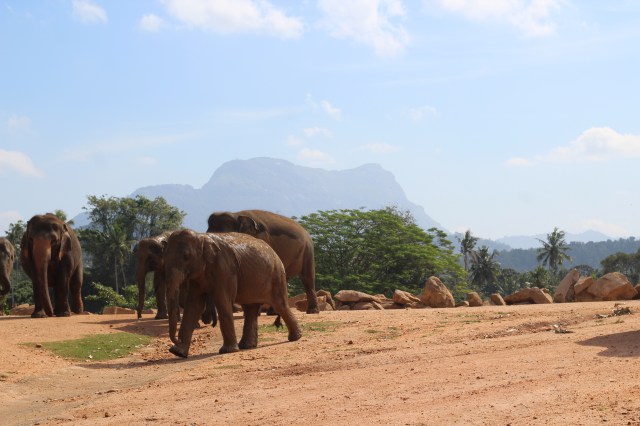
Sunday Funday…with Elephants!

Once upon a time (2017) I spent Christmas in Sri Lanka. post here

Quite often, spending the holidays abroad (especially Christmas day) can be a lull in the otherwise grand adventure. I find that hitting a non predominately Christian country, and planning an epic excursion can quickly combat the holiday blues. This trek to Sri Lanka was completely unexpected, so an elephant sanctuary seemed totally appropriate.

I talked a bit about the sanctuary in the previous post,  but wanted to expand on that and include more pictures. The Pinnawala elephant orphanage hits hard right in the feels.

IMG_2327

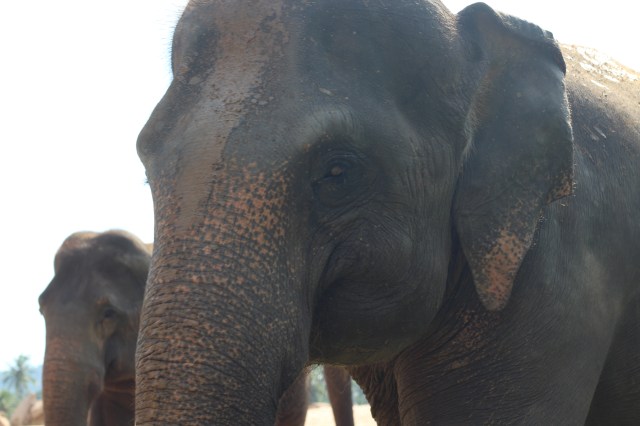
Pinnawala  is an orphanage, nursery and captive breeding ground for wild Asian elephants. They have the largest number for this type of orphanage anywhere in the world. This isn’t a situation where you ride them, bathe them, or they are forced to perform tricks. I’ve been to those type of places, and they can be a quite a bummer. These are wild animals, rescued and rehabilitated, so you can observe them, but that’s about it.  Pinnwala was founded in 1975 for baby elephants orphaned in the wild. They currently have 85-90 elephants on site.

IMG_2329

The site sits around 2 hours outside of the capital city of Colombo. When arriving by mid day, one is treated by watching the elephants’s daily trek to the river. (my favorite part)

Christmas with the family can be awesome, but it can also be an exercise in drama filled frustration. Good news about elephants…no such thing!

IMG_2342

Who doesn’t want/need a day with these amazing animals?!

IMG_2338

I will eventually write longer pieces about traveling over the holidays, this is just an excuse to share elephants and spread some joy at the end of the weekend.

IMG_2381

IMG_2358

There is something about a day spent on a river full of frolicking rescued elephants, snapping a few pics, sipping lime juice smoothies and enjoying bright warm weather… best Christmas present in recent memory.

IMG_2384

I’ve found that

“To awaken quite alone in a strange town is one of the pleasantest sensations in the world.”


Happy Sunday!

IMG_2462

The Silver Lining/Solo Travel Pt2

p8cvVmW“I want to travel, but i’m scared to go alone”.
I was too once upon a time, and an unlikely turn of events kicked my ass right out my front door. 


Disaster strikes at the most inopportune times.  From my last post, here: (https://gypsyprofessor.com/2018/01/24/on-the-path-to-solo-travel/)

I was all set to book tickets to south eastern Europe, only waiting on my friend to stop by and pull the proverbial trigger on airfare.  We had waited for weeks. I was pouring over Instagram and travel forums looking at pictures of Sarajevo, Skopje, and Dubrovnik. I was obsessed with getting over the pond. It had been far too long. I missed the feeling of the unknown, the swirl of foreign languages and the assault on the senses.  We were all set.

My buddy’s excuses had put pressure on the entire process and played a bit of pinball with my level of anxiety. Almost a month delayed now, he finally  showed up, but not to book…to give me one final, and fatal fucked up excuse.

“Hey man, bad news, I don’t think I can pull it off, I cant get the time off work..etc, etc.

All of the eye roll emojis in the world could not convey my feeling at that moment.


I was crushed. 


Absolutely crushed.  I felt betrayed, frustrated and pissed. My carefully constructed plans dashed and disregarded. But there was more.

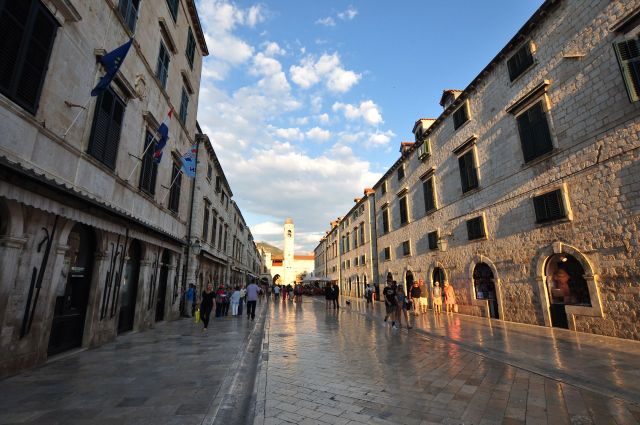
Dubrovnik

Now that I was in my doldrums, I walked away from the computer and my buddy  for the remainder of the afternoon. I went for a walk. I  attempted  to console myself with other options, a road trip maybe, or something domestic. I pondered and I plotted. Tied up in a knot of frustration,  and angst, I felt no progress near at hand.

Eventually that night, I ended up back at my place, and in a deep google routed rabbit’s hole. I ended up falling back on some trusted wisdom from some personal favorites. Bukowski, Hunter S Thompson, and Henry Miller.

“We are all alone, born alone, die alone, and—in spite of True Romance magazines—we shall all someday look back on our lives and see that, in spite of our company, we were alone the whole way. I do not say lonely—at least, not all the time—but essentially, and finally, alone. This is what makes your self-respect so important, and I don’t see how you can respect yourself if you must look in the hearts and minds of others for your happiness.”  -HST
I peeled back a few layers of the onion and thought about why I thought I had to rely on other people for this particular dream.  I realized that nothing great comes easy. The people around me had 1,000 excuses not to pursue their dreams. I had reached a point where I refused to be one of them.
IMG_0235
“Fuck it”
“I’m going solo”
This was one of the most defining decisions of my life. As of this writing I have traveled to 69 countries. Some years I travel over two hundred thousand air miles. Travel becomes an obsession. Words like “tourist” no longer have any meaning for you.    The vast majority of these adventures  have been solo. Christmas in Sarajevo? Or Perhaps visiting an elephant sanctuary in Sri Lanka? Few are signing up for that.  That’s perfect.
“Learning to let go should be learned before learning to get. Life should be touched, not strangled. You’ve got to relax, let it happen at times, and at others move forward with it. It’s like boats. You keep your motor on so you can steer with the current. And when you hear the sound of the waterfall coming nearer and nearer, tidy up the boat, put on your best tie and hat, and smoke a cigar right up till the moment you go over. That’s a triumph.”
Either embrace the unknown, or get comfortable in the wet pantload of your excuses to stay stagnant.  It  was time for me to take flight. Lets grab this ticket and make the most of it!
Aw shit. Another hurdle rises in the mist.   My saved routes to Budapest, Vienna, and Zagreb had doubled since the afternoon…I’m in the zone though, I cant be stopped. Embrace uncertainty, shed the illusion of control right?
So I rolled the dice, I frantically dissected the map of Europe, I held my breath for that sheer burst of serendipity, shit, I would have been ecstatic for  divine intervention at that point as well. Into the wee hours of the morning, the siege on my ticket prices finally broke. What a 3 am Rush!   Where am I going to land?!
Ladies and gentlemen… Looks like we are headed to Lithuania!!
Wait, what? Lithuania!?
Giddddddy Up!
Baltic adventure/pt 3  coming up next!
Happy weekend!

On the Path to Solo Travel

3 years ago I was super stoked.  The summer had descended on Michigan, I had a teaching assignment at the college secured and a great group of friends. I had gone through a wrenching breakup a few months previous, and had reorganized/re focused my life in a drastically more positive direction. (You know, that good growth stuff of your late 20’s) Now,  I had traveled before, I had been on a few study abroad excursions, and had made some amazing connections over the pond.  It had been a year or so since I had been abroad.

The itch was real.

Roads_Mountains_Alaska_444230

I thought about it constantly. I began mentioning to my group of friends casually.

“We should totally hit Europe this summer”. I wanted  miles under my feet, and crazy new sensations. Those damn motivational prints all over social media haunted me “Not all those who wander are lost” Etc, etc.

I began hatching some carefully constructed plans, seeing how I could convince my buddies to come along.

Finally after a few weeks, one particular friend who had never been outside of the country, declared over beers “Im in”! And the planning began in earnest.

Where would we go? I was keen on the Balkans, and the Baltics. I was planning on roughly 10 days. Swayed by the scenery of Croatia, and the mountains of Bosnia we decided on the former Yugoslavia.

38216566932_e69a8edbb2_b

At this point I was watching flights daily, frantically refreshing, waiting for just the right combination, connections, and overall logistics.  I would text my buddy my findings through out the day

“Dude, DTW-BUD now 550$”

He would reply “Yeah man, lets do it!”

Later, when it was time to book, some sort of excuse would seemingly always emerge. I was getting anxious, watching flights rise and fall like the stock market. While trying to set a day to book I would read more about our intended region

37437103200_066e2f8f70_b

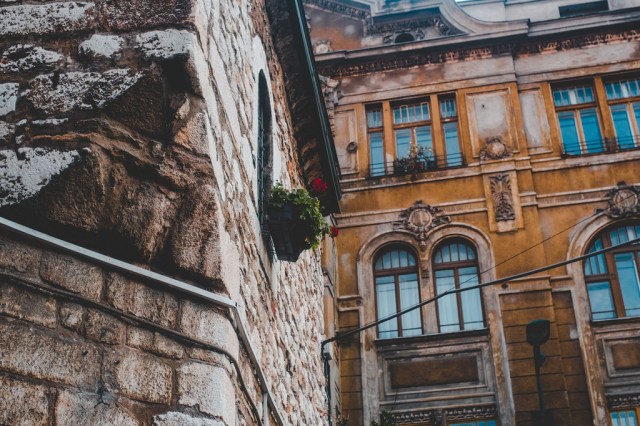
Sarajevo in particular looked beyond kick ass. The history, the culture…the food! I wanted to book NOW.  It was ultimatum time. Either we are booking or this, or it’s a no go….the day comes, we are getting together after work, its time to lock this in….


and then disaster strikes.


Pt 2 coming up next!


leave some love!

Notes about a “Shithole” country.

WASHINGTON — Once again, Haiti, a country with deep historical ties to the United States, is in the news. Once again, a negative narrative permeates the public dialogue and Haitian people are compelled to defend our humanity. Once again, the circumstances require us to wage a battle on two fronts: tackling the physical rebuilding of our nation so that future generations can prosper, while simultaneously combating prejudice and stigma that risk being, over time, institutionalized in the American consciousness.

Over the Christmas weekend, Haiti found itself the subject in a public spat between two major American institutions, the White House and The New York Times, over some comments the president allegedly made regarding Haitians and the AIDS epidemic.

While the controversy, fortunately, has receded from the headlines, it brought back painful memories for Haitians of a sad chapter in the United States’ public health policy. In the 1980s, the Centers for Disease Control and Prevention issued official warnings that simply being Haitian made a person more likely to contract HIV. The C.D.C. eventually — and rightly — dropped the unsubstantiated claim.

The reports of the president’s supposed comments — and the ensuing discussion of them — fit into a broader, troubling continuation of a narrative that is far too common in the United States, one that stigmatizes Haiti and Haitians as nothing more than the sum of natural disasters and instability, a country rampant with death and disease. In many American eyes, Haiti is in perpetual need of charity. This attitude provokes “compassion fatigue” — or worse yet, disdain.

img_9799


It is long past time for such thinking to end. Influential American news outlets and political leaders should lead the way by resisting the reflexive tendency to paint Haiti and its people, whether living at home or abroad, with broad-brushed narratives that lack historical context and oversimplify complex socio-economic realities.

Haiti has been a vibrant, steadfast hemispheric partner since its birth. Hundreds of Haitian soldiers fought in the Siege of Savannah alongside American troops to battle British imperialists in the Revolutionary War. Sparked by this nation’s commitment to independence and freedom, Haiti soon followed with its own revolution, throwing off the shackles of slavery and colonialism. Thus, Haiti and the United States represent two of the oldest republics in the hemisphere, bound by dignity and a pursuit of freedom for our peoples.

The Haitian-American population has made significant contributions to American culture and the United States’ economy. Jean Baptiste Point du Sable, a Haitian man, founded the city of Chicago in the 18th century. W.E.B. Du Bois, a leader in the American civil rights movement and a man of Haitian heritage, played a key role in creating the intellectual framework for equality for African-Americans.

Today, Haitian-Americans serve in the United States armed forces, and they represent their communities in state houses and on City Councils around the country. They are prominent scientists and engineers; they are taxi drivers, doctors, nurses and professional athletes. They are public-school teachers and university professors.

As Haiti’s ambassador to the United States, I have witnessed firsthand the Haitian people’s dignity, perseverance and resourcefulness. I have seen my people’s commitment to rebuilding communities and restoring homes after hurricanes. I have seen how young entrepreneurs in Haiti are now making exquisite chocolates to export to the United States. I have seen how engineering students in Haiti are now using technology to work remotely with Haitian-American engineers on disaster prevention.

These are examples of the countless positive initiatives underway in Haiti, with the support of the diaspora. Yet these attributes seem to be chronically lost in wider conversations about the Haitian people.

The recent controversy over President Trump’s alleged remarks have resurrected painful memories for Haitians. But it is a reminder of the urgent need to change the way our country is discussed in the United States. The narrative about Haiti should reflect our government’s development priorities.

We want our country to create wealth and prosperity for its citizens, not be viewed just as a recipient of humanitarian aid. Rather than American businesses donating excess inventory to our country, we are hoping they will invest in our country. Rather than students spending a week of spring break doing volunteer work, we want them to study abroad for a semester at one of our universities. Rather than writing a check to a charitable organization like the Red Cross, take a vacation on our beaches.

Given our two countries’ long intertwined history, it is time to we get to know each other on a level of mutual respect and understanding.

IMG_0078

These pictures are mine, taken just a few weeks ago. Do you have a story about Haiti? Do you need to vent some political rage about this situation? Drop a line.


comments welcome.

Friday Motivation


img_8899

The weekend is nearly upon us! It’s time once again to momentarily shed the office shackles and wander a bit farther afield…Even if only in our imaginations.

Today’s blurb comes to us from an unlikely source.


Remember that there needs to be a balance, don’t kill your self for a company/job that would replace you in minutes.

Take care of yourself.

“The less you eat, drink and buy books; the less you go to the theatre, the dance hall, the public house; the less you think, love, theorise, sing, paint, fence, etc., the more you save – the greater becomes your treasure which neither moths nor rust will devour – your capital. The less you are, the less you express your own life, the more you have, i.e., the greater is your alienated life, the greater is the store of your estranged being.”

– Karl Marx, 1844


img_7846

Now rock that weekend!

Caribbean dreamin’

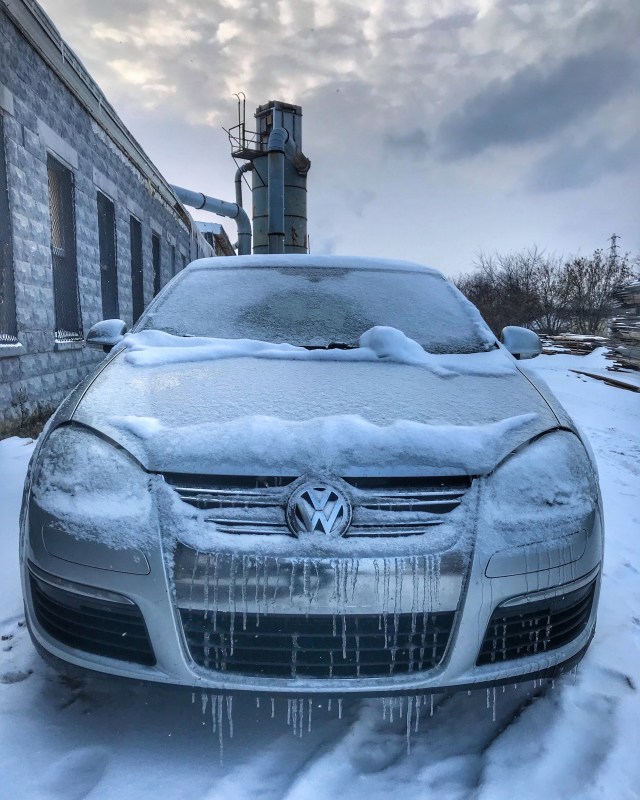
It’s been damn cold here in Michigan. As friends have not hesitated to remind me, I seem to have missed the really cold days, but I’m rather frigid none the less.

As the semester is underway and the rhyme and flow of the “grind” has set in, I’ve been thinking of Haiti yet again. I’ve been thinking of the island nation on a few different levels.

The first of which is downright adversity. Our last full day on the island was dedicated to a roadtrip to the sea. We tried to go the day before, yet couldn’t find a car. After overcoming this obstacle through much time, hard currency and angst, we then could find no fuel.

What?

That’s right. Port Au Prince was seized by a petrol crises. When was the last time you couldn’t go somewhere because when pulling into your local gas station a 12 gauge wielding team of guards informed you “no gasoline”?

Makes for a frustrated road trip. But this is a common occurrence for Haiti, especially in the capital. The solution? Dollars and time. Our fixer cobbled together a gallon here, a gallon there. We were set for early nothing the next day. To the sea we will go!

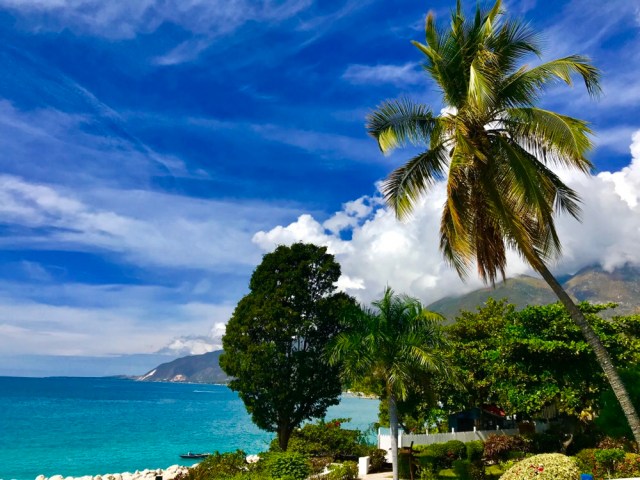
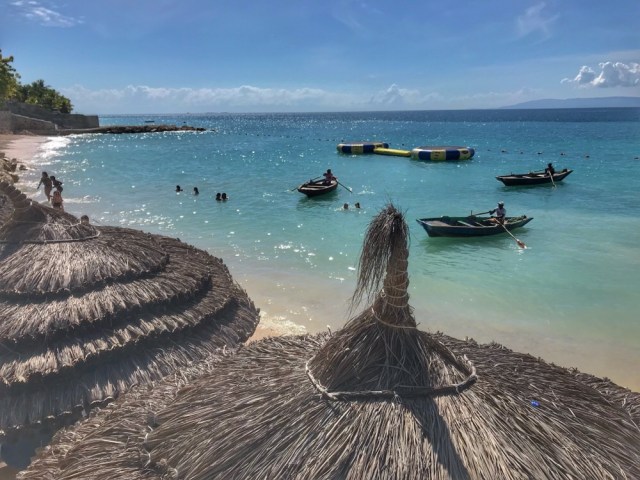
A mere hour outside the city is akin to visiting another planet. This is what I had imagined when thinking of a quick week run immediately before the semester. You know, coconuts n shit. Sandy beaches. Drinks with wee umbrellas.

Taking a day to lounge along the Côte des Arcadins is majestic. Slow, easy and not butchered by gaudy resorts. This day on the sea allowed me to begin to wrap my mind around Haiti. I had gone from the context of adversity to one of calm beauty. I did drink out of a damn coconut and floated for a while. These memories are extra potent when confronting sub zero Michigan temps. My final layer/level to Haiti that comes to mind is sheer tenacity. The savage beauty of the landscape as well as the people. I think back to the Ghetto Biennale, and Andre Eugene, the resident artist and curator. I think of seeing the kids of the art collective assemble amazing pieces, and having literally nothing. Living in a tent city.

I think about the grit that it takes to create, despite living in actual realized destruction. While I listen to my students bitch about the battery life of their new iPhones wearing their pajamas to class because they can’t be bothered to find actual pants. They “can’t even” as they say.

I think about Haiti. I think about how this place caught me off guard. Destroyed my intestinal tract, proved much more expensive and difficult than originally intended, how it caused friction among friends and could prove absolutley exhausting. But all of that aside, Haiti changed my perspective. I gassed up my private automobile yesterday…without issue. I drive where I want and things around me work for the most part.

You should smile about that.

Our political situation is nutty, with the US president calling Haiti a “Shithole” and promising to deport more Haitians…and this isn’t the post to delve into colonial legacy, but it’s something that deserves far more attention than it currently gets.

I think about Haiti, and I smile. I’m thankful for seeing a vastly different world, and yet again what that human spirit is capable of.

Thank you!

Please check out The Gypsy Professor now on Facebook here:

Comments and feed back always appreciated.

Weekend thoughts

5 weeks on the road. (With a few runs home mind you). Makes one think.

I wanted to share a few weekend words with you.

Don’t get stuck. Move, travel, take a class, take a risk. There is a season for wildness and a season for settledness, and this is neither. This season is about becoming. Don’t lose yourself at happy hour, but don’t lose yourself on the corporate ladder either. Stop every once in a while and go out to coffee or climb in bed with your journal. Now is your time. Walk closely with people you love. Don’t get stuck in the past, and don’t try to fast-forward yourself into a future you have yet to earn.

Keep moving forward.

Happy Saturday.

The End of the World…Caribbean style.

I’ve been back in the states a few days now. Here in west Michigan the traffic is mostly minimal. The winter semester has kicked off and the daily grind is in full effect. The weather has moderated and a sense of relative normalcy has returned.

The transition back from Haiti has been a startling one. I’m thinking back on the shocking week around the Haitian capital and I’ve noticed it resonates daily.

It’s time to talk about Haiti.

There is poor…and then there is Haiti poor. I’m going to come out and say it. I’ve never been anywhere like this. Ever.

I’ve been some places, I’ve seen some shit..but nothing like this. Shocking on multiple levels on a daily basis. I tried to place and contextualize all of this brutal new input…and finally it came down to post apocalyptic imagery, books, movies…Mad Max type shit. Here’s the kicker though…Mad Max set on a Caribbean island with a cool sea breeze.

How’s that for bizarre?

I will tell you this. Most go here from the states with a well intentioned but condescending super white pity. They come down for a week with a Church, bang out a another church, feel like they saved the world. Pat them selves on the back and go home with a bracelet.

When you show up as a “tourist” most Haitians are quite confused. They give you this look essentially saying “the fuck are you doing here?!”…takes a bit getting used to.

KNOW THIS. (Thank me later)

You will accomplish absolutley, positively, nothing in Haiti without a fixer. A local keen to help you and show you how to navigate the insanity in return for your American dollars. Accept this, embrace it and enjoy.

Haiti is a place that slays spontaneity. My usual travel style died a painful awkward death by the second day in country. But once a solid fixer entered the picture, the layers of this turbulent island began to peel back a bit for a wee peek.

This is where I will directly recommend my man Richard. (Jacques Richard Miguel) his story is as rugged and awry as the local landscape. Richard grew up in New York, after his parents immigrated from Haiti in the 1960s. He soon discovered rock n roll, and the party that raged along with it in the 1980s. Richard eventually succumbed to a crack addiction and was arrested stealing from a department store to get his fix. He was deported back to Haiti in 1988. After getting clean Richard had no choice but to adapt to his new yet native home. (He has been clean over 12 years) His observations and insights delivered in New York accented English and rapid fire French are priceless and reveal keen tidbits about modern Haiti. (Please drop me an email or a comment for his contact info.)

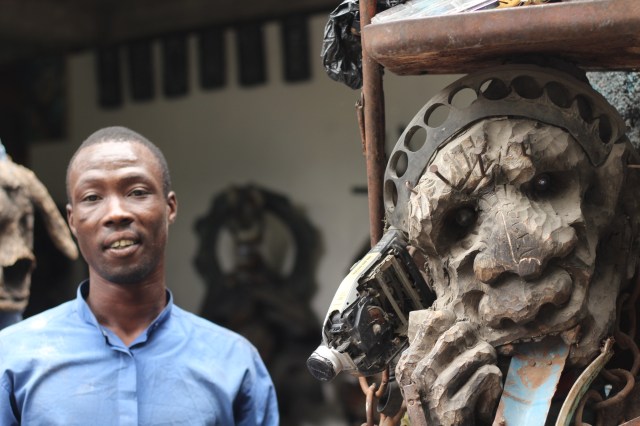
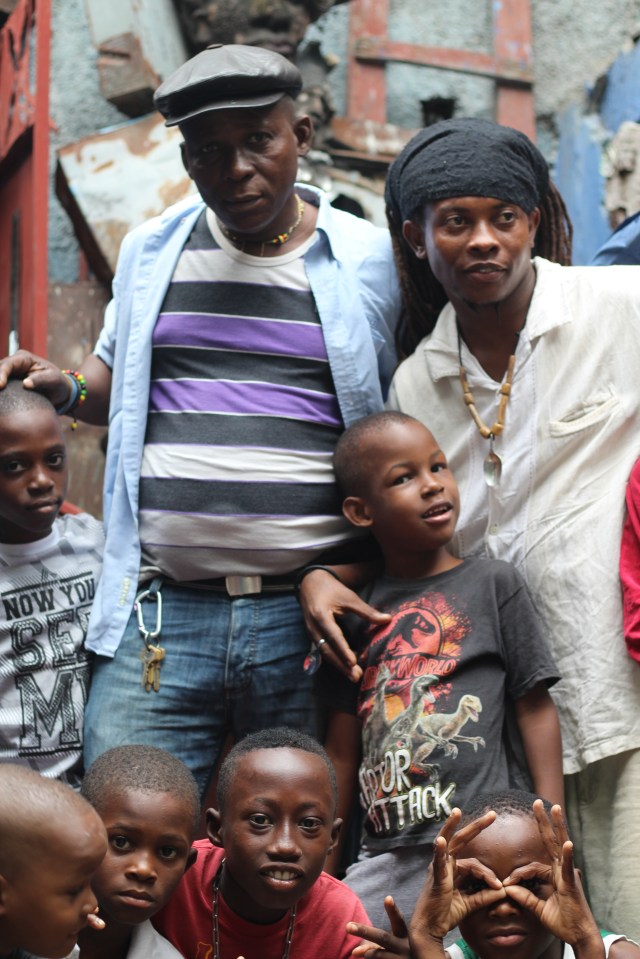
Through Richard we were able to discover the gnarled yet throbbing art scene expanding in the capital. The best example of this being the Ghetto Biennale. This “art gallery” literally sits among the tarp/trash city within Port Au Prince and is run as a collective. This is also the coolest fucking gallery I’ve ever visited. No pretension here. Every piece is made 100% from collected garbage. Kids collect the pieces and learn how to craft/create. This is raw, this is real, and completely kick ass.

These aspiring young artists show amazing skill and tenacity. We enjoyed joking and a few candid photos on this afternoon visit.

You come to realize that “garbage” in Haiti includes metal, car parts, glass, body parts, etc. upon realizing the abundance of real skulls I was told “after earthquake, we find everything”. For a very somber moment I let that one sink in while admiring the twisted beauty of these pieces.

Voodoo themes abound and flow through the reality that is life in the capital.

Next up on the agenda is the attempt to roadtrip outside of the capital…sounds easy enough right?

Didn’t I tell you this one was going to get weird? I’m still ripping through thoughts and words back here where things mostly work, and I don’t have memories of an earthquake that claimed near half a million lives.

Want more Haiti?

Drop a comment with your thoughts.


If your’e feeling saucy, check out this new Kindle travel gear as well.

Shop All-new Kindle Travel Gear